Copper’s sudden jump from the 700s to ~1200 in just a few months isn’t just a commodity story — it’s a technology story getting interrupted mid-flight.
For years, the Indian water-heater market quietly evolved around Copper tubular heating elements. Not because copper is “premium” in a brochure sense, but because it is forgiving: excellent heat transfer, stable forming behavior, and a long history of proven reliability in Indian usage conditions. In fact, almost every meaningful innovation in the last couple of years has been built around copper — PTFE coated copper elements, improved copper bending without thinning, tighter tolerances, better terminal sealing… basically, the market was upgrading without changing the core metal.
And then copper prices took off.
When your element becomes the single biggest cost driver, manufacturers start looking for “quick wins.” The loudest and most tempting one is obvious: shift everything to Stainless Steel tubular elements.
Here is where the market needs to pause and think.
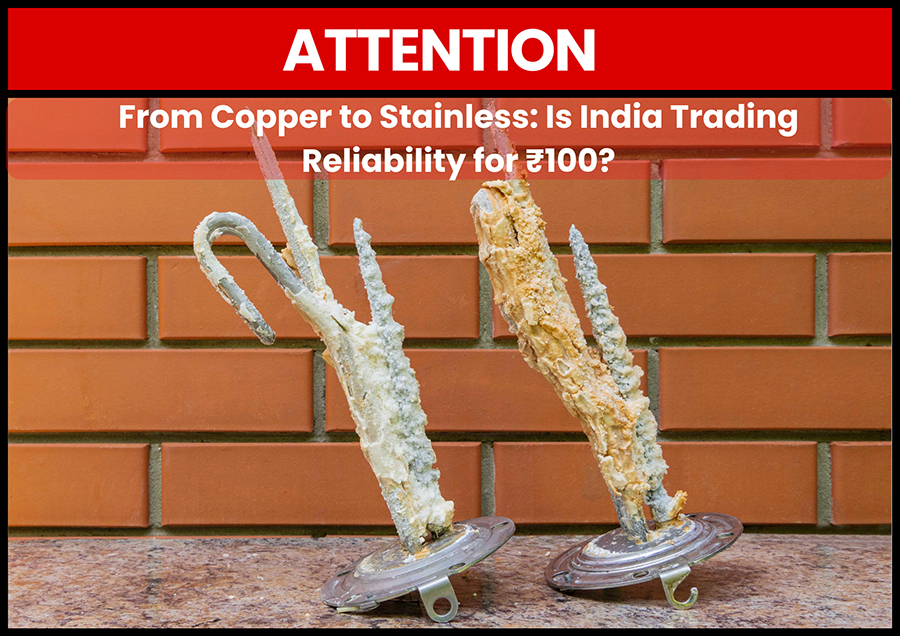
Because SS was never rejected in India due to fashion — it was rejected because of performance risk, especially in Indian water. Indian domestic water conditions are brutal: high TDS, chlorides, hardness (Ca/Mg salts), and in many regions a mix of borewell + municipal supply. In such conditions, stainless steel is not merely “a cheaper alternative.” It brings new failure modes: faster scaling in many cases, local pitting if material selection is wrong, higher chances of early leakage if forming and welding quality is not elite, and in general, a much smaller margin of error.
And no — the testing is not as mature as people claim. Most validation is short-cycle lab testing, not the ugly long-duration reality of Indian households: 2 years of variable voltage, dry heating incidents, low-water usage, and poor earthing.
This is why the SS rush is dangerous: when the pressure is cost, the market tends to adopt SS-304-ish solutions as if they are copper replacements. They are not. Premium companies understand this, but mass adoption usually drives quality down.
The irony? We are taking this risk to save ?70–?100 in a geyser — a product that lives in bathrooms, above heads, in wet electrical environments. For an immersion rod you can see, clean, replace cheaply — fine. But for concealed storage water heaters, this “small saving” may become a big reliability and safety compromise.
Meanwhile, alternatives exist and are proven globally: Incoloy sheathed elements, glass-lined (vitrified enamel) elements, and corrosion-resistant architectures designed for hard water regions.
The copper price shock will definitely reshape the heating element market in India. The only question is:
Will it reshape it responsibly — or will it reshape it cheaply?